
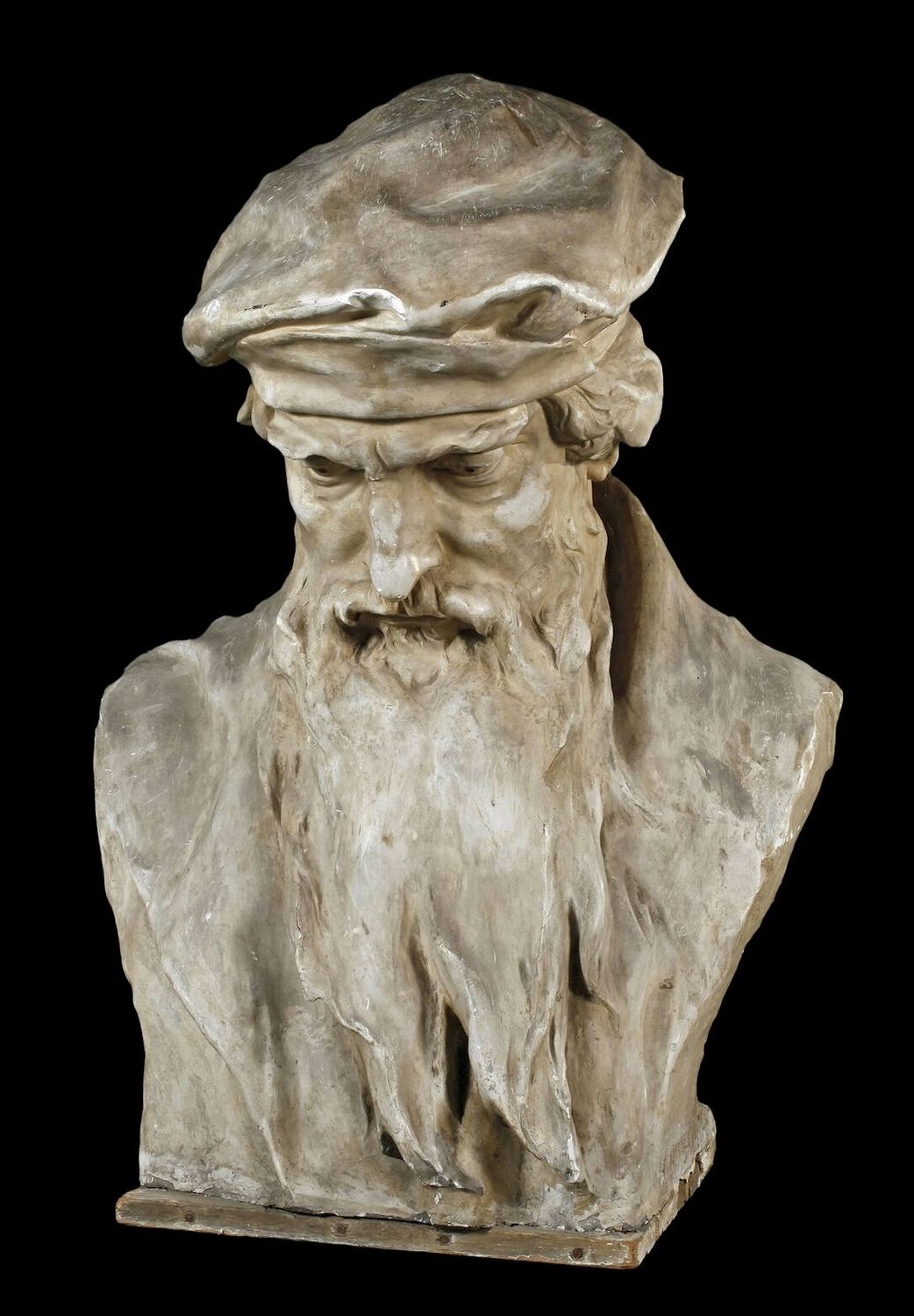
Bitterlich, Hans (1860–1949), Johannes Gutenberg, 1900
Hans Bitterlich(1860 Vienna – 1949 ibid.), Johannes Gutenberg , 1900. Plaster on wooden base, 95 cm (height) x 65 cm (width) x 50 cm (depth), approx. 30 kg, signed “H. BITTERLICH” on the side.
- Showing heavier wear in places and minor chips
- The Fate of Humanity -
This larger-than-life, monumental head is believed to be the 1:1 model for the head of the Johannes Gutenberg monument erected in 1900 on the Lugeck in Vienna. Designed to be viewed from below, the head with its flowing beard is equally that of a thinker and a prophet. The heavy humanist cap depicts Gutenberg as the initiator of a cultural revolution. Through the printing press, not only will every person ultimately be able to partake in the source of knowledge in the future, but the new medium’s capacity for expression also accelerates the production of knowledge in ways unforeseeable at the time. It is precisely these consequences that Gutenberg—filled with deep solemnity—seems to foresee with a prophetic gaze. The prophetic quality is reinforced by the facial expression, reminiscent of Michelangelo’s Moses, and the flowing beard. Above all, however, the face expresses an immense will in the Nietzschean sense, with which Gutenberg has achieved a victory that determines the fate of humanity, a victory that simultaneously causes him to reflect on the fate of humankind.
About the Artist
Johann “Hans” Bitterlich was the son of the sculptor and history painter Eduard Bitterlich. He studied sculpture under Edmund Hellmer and Kaspar von Zumbusch at the Vienna Academy of Fine Arts. In 1886, he won the Rome Prize—which included a two-year scholarship to study in Italy—for his life-size plaster statue *Motherly Love*. From 1890 onward, he was a member of the Vienna Künstlerhaus, participating regularly in its annual exhibitions. From 1901 to 1931, he served as a professor at the Vienna Academy.
Hans Bitterlich belonged to the younger generation of Ringstrasse sculptors who, starting from the Neo-Baroque, moved toward Art Nouveau. Bitterlich created numerous monuments, of which the Gutenberg Monument at Lugeck in Vienna (1900) and the seated figure of Empress Elisabeth (1907) are his most significant works. In 1887, he received the Vienna Künstlerhaus Prize; in 1894, the Imperial Prize at the 3rd International Vienna Art Exhibition; in 1931, he was awarded the Austrian Cross of Merit; and in 1943, the Goethe Medal for Art and Science. Joseph Goebbels placed him on the so-called “List of the Divinely Gifted,” comprising artists deemed important to the Nazi state.