
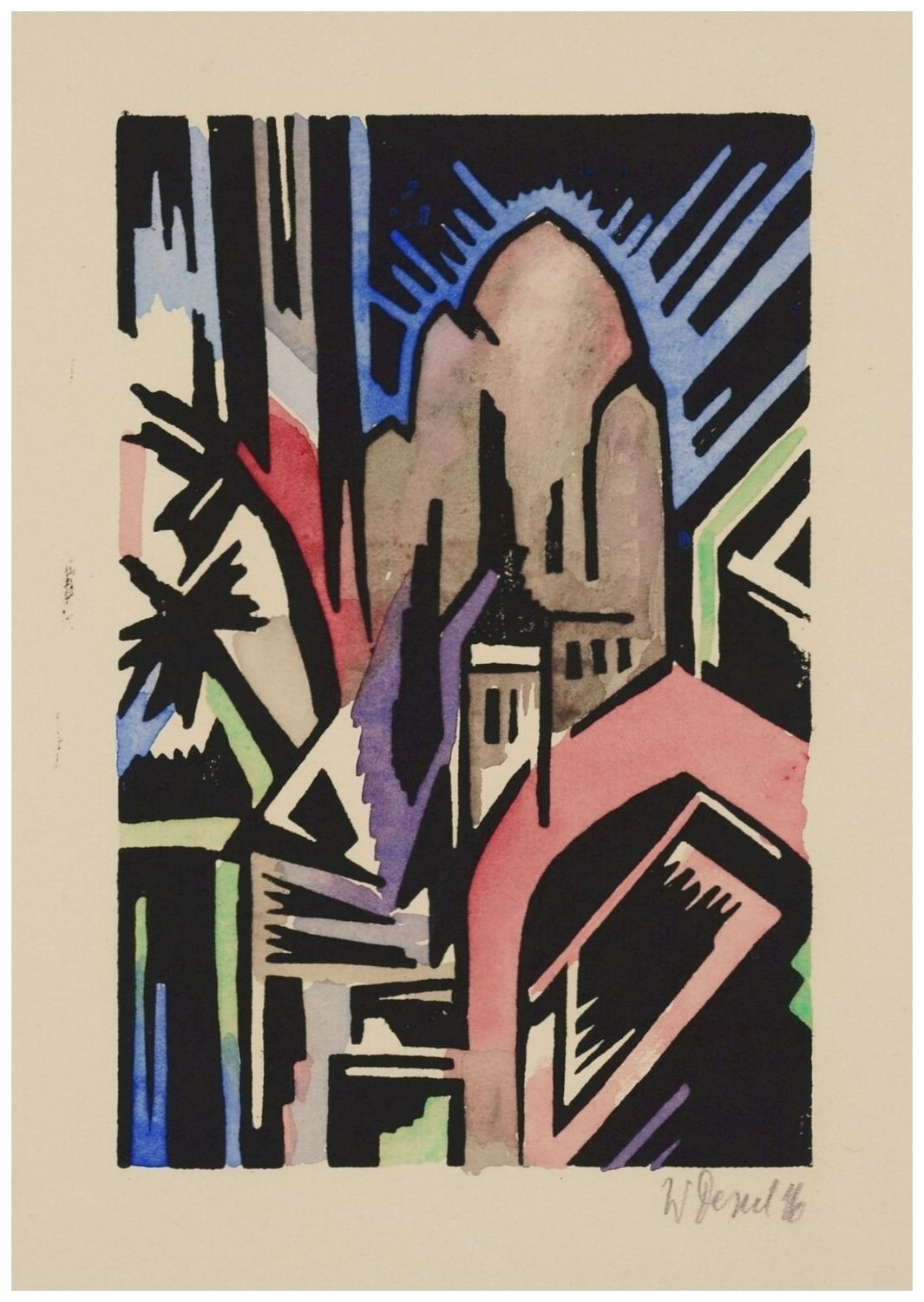
Dexel, Walter (1890–1973), Mosque, 1916
Walter Dexel(1890 Munich – 1973 Braunschweig), Mosque , 1916. Watercolor woodcut on handmade paper, 15.5 cm x 10 cm (image), 29 cm x 22.3 cm (sheet size), signed “WDexel 16” in pencil at the lower right of the image and dated 1916, identified as copy no. “4/30” at the lower right, titled “Mosque” at the lower left, and marked “hand-watercolored.” Walter Vitt catalogue raisonné no. 3A.
- Paper slightly darkened and partially stained outside the image; image in fresh-colored condition
- The Expression of Architecture -
From dynamic black planes, a scene emerges explosively, from which the mosque rises. The stone-colored, cohesive architectural structure is the actual focal point of the protrusions. The blue aura of light, with its outward-directed rays, permeates the entire image with its shades of blue. The yellow-red colors next to the mosque and the stylized palm trees evoke the rising sun and feed their energy into the dynamic action, while the nature-inspired green tones complement and balance the color crescendo.
Using the innovative technique of applying watercolor to the woodcut, Walter Dexel intensifies the scene, which—with its radiant mosque set against a storm of color and form—is also an icon of Expressionist architectural visions. Thanks to the watercolor application, each copy of the woodcut is simultaneously a painting and, as such, a unique piece.
About the Artist
Walter Dexel studied art history at Ludwig Maximilian University in Munich from 1910 to 1914 under Heinrich Wölfflin and Fritz Burger. At the same time, he attended a drawing school and began to pursue artistic activities. He undertook study trips to Italy and Paris. In 1916, he earned his doctorate at the University of Jena, and in addition to his own artistic work, he subsequently served as exhibition director of the Jena Art Association until 1928, where he promoted modern art and organized important exhibitions. Among other things, he acquired works by Alexander Archipenko, Alberto Giacometti, Erich Heckel, Paul Klee, Oskar Kokoschka, and Emil Nolde, and organized Dada evenings and exhibitions featuring Expressionists, Bauhaus artists, Realists, and Constructivists.
Starting in 1926, Dexel worked as a freelance graphic artist and designer in Frankfurt am Main, creating advertisements and typography, including for the “New Frankfurt” project under Ernst May. From 1928 to 1935, he taught commercial art and cultural history at the School of Applied Arts in Magdeburg. Later, he served as a professor of theoretical art and form in Berlin and, beginning in 1942, built up a significant collection of everyday objects in Braunschweig. After World War II, he continued his teaching and research activities and, starting in 1961, devoted himself once again more intensively to painting.