
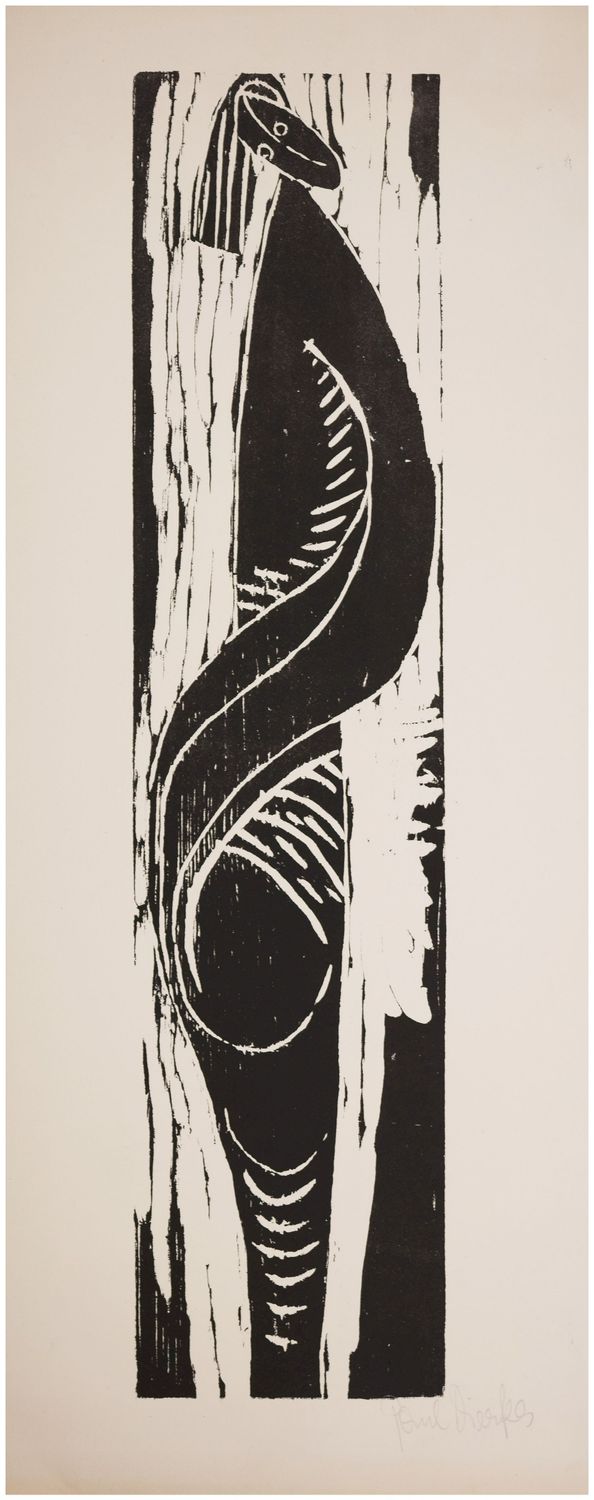
Dierkes, Paul (1907-1968), Sculptural Female Figure, c. 1955
Paul Dierkes(1907 Cloppenburg - 1968 Berlin), Sculptural Female Figure , circa 1955. Woodcut on heavy handmade paper, 74.5 cm x 30 cm (sheet size), 64.5 cm x 15 cm (image size), signed “Paul Dierkes” in pencil on the lower right.
- The wide border is slightly scuffed in places and has darkened in the lower area, but the image is in very good condition.
- The essence of wood -
Paul Dierkes, who worked with the natural materials of stone and wood, also devoted himself to woodcuts, approaching them from the perspective of a sculptor who artistically transforms the material based on its inherent qualities. A white bark-like structure can be seen across the width of a tree trunk, within which a black female figure grows, traversing the image. The sculptural figure reveals the true essence of the wood.
About the artist
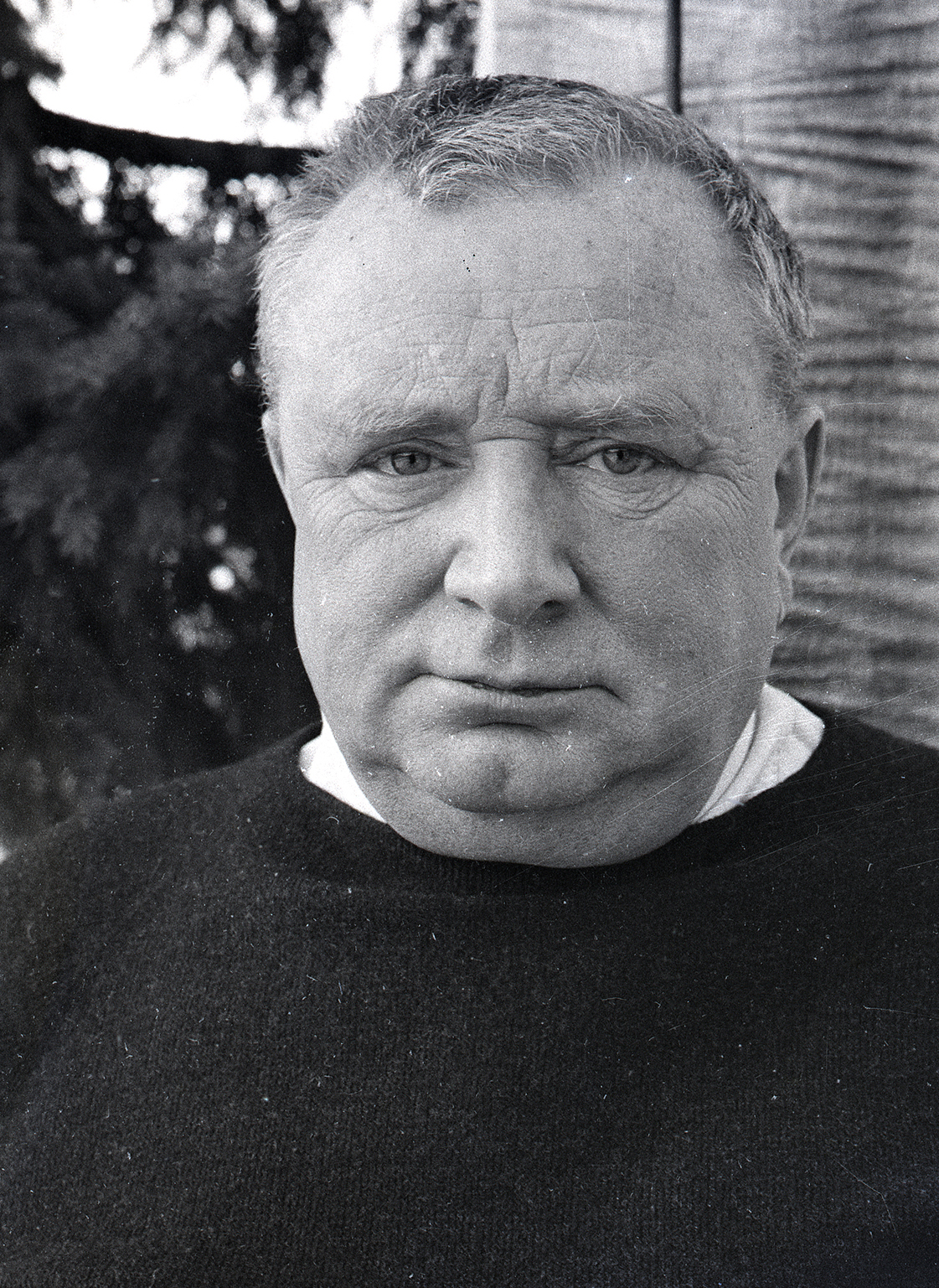
Paul Dierkes by Gert Chesi, around 1964 /
CC BY-SA 4.0
As the son of a stonemason, Paul Dierkes was familiar with stone from an early age. After an apprenticeship as a stonemason, he decided to explore this material artistically and become a sculptor. He first studied at the Königsberg Art Academy under Stanislaus Cauer. In 1931 he transferred to the Munich Academy and received a scholarship to Rome. He then settled in Berlin. His first solo exhibitions followed, including at the Ferdinand Möller Gallery in Berlin and the Augusteum in Oldenburg. Dierkes undertook study trips to Amsterdam, Prague, and Paris.
To avoid being drafted by the Nazis, he left Berlin and settled in Groß-Glienicke after the war, but moved back to West Berlin after the division of Germany.
In 1947, he was appointed to the Berlin Academy of Fine Arts and became a professor in 1948. For 20 years, until his death, he headed the Department of Stone and Wood. One of his students was Heinz Spilker.
Paul Dierkes is one of the protagonists who established modern sculpture in post-war Germany. He created archaic-looking forms that exude an aura of originality and, with their figurative allusions, also have a high symbolic value. The original effect gives his art a kinship with architecture, which led Dierkes to collaborate with Egon Eiermann, Peter Poelzig, and Sep Ruf. Many of his works characterize public spaces and demonstrate that Dierkes also understands sculpture as a monumental art that auratizes the respective location through a formed originality and thus develops a social relevance.
The aesthetic effect of sculptural originality often goes hand in hand with an emphasis on "being made," which underlines the craft aspect of the act of creation. For this reason, Paul Dierkes was also fond of woodcuts, which are related to the art of carving.
In 1954 Paul Dierkes was awarded the Art Prize of the City of Berlin.
Every idea creates something we suspected but did not know.
Paul Dierkes
The young Paul Dierkes already had the ability after his four-year apprenticeship as a stonemason to fathom the properties of each selected piece of wood and each stone and to figuratively transform individual natural processes of the grown organisms by means of his own working process.
Herbert Wolfgang Keiser
Bibliography
Herbert Wolfgang Keiser: Der Bildhauer Paul Dierkes, München, 1977.