
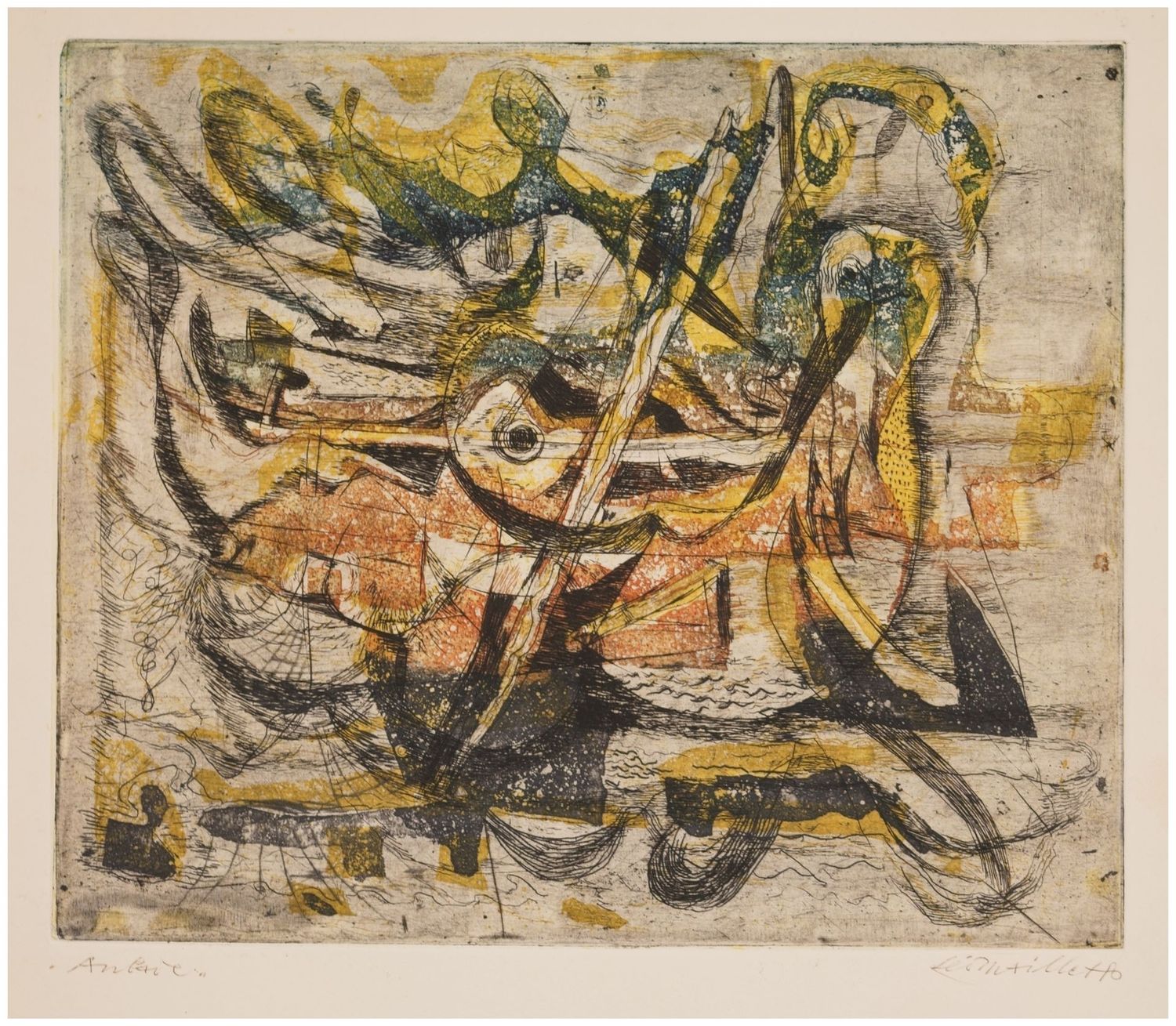
Maillet, Léo (1902-1990), Aubade, c. 1960
Léo Maillet(1902 Frankfurt am Main - 1990 Bellinzona), Aubade , around 1960. Color aquatint with etching and drypoint on sturdy, chamois-colored wove paper, 23.5 cm x 27.9 cm (plate size), 51.5 cm x 37 cm (sheet size), hand-signed, titled, and marked “Epreuve d'Artiste 1/5.”
- Magnificent print. The wide margin with minimal crease marks and partially slightly darkened
- Vibrant imagery -
During his time in Switzerland, Léo Mallet intensively explored the ‘sonority’ of images. Here, the graphic depicts an aubade, a morning serenade, which is the counterpart to the serenade, the musical evening piece. We see an upright figure spanning the image, connected to a string instrument. A resonant entity that unfolds a sound space, carried equally by the vibrating filigree lines and the yellow, orange, and green colors. This sound space in turn opens up worlds of sound, such as the wave-like structures in the lower right area of the image. In this way, the image itself becomes music.
About the artist
Léo Mallet, whose real name was Leopold Mayer, attended Franz Karl Delavilla's graphic arts class at the Städelschule in Frankfurt from 1923 onwards with the aim of becoming a fashion designer. After deciding to devote himself entirely to art, he became a master student of Max Beckmann in 1930. After the Nazis came to power, the Beckmann School was dissolved and almost all of Léo Mallet's previous work was destroyed. He fled to Paris, where he worked in the same studio as Picasso and Miró. Between 1936 and 1939, he participated in several art exhibitions in Paris, while in 1937, artworks still in Frankfurt were destroyed as “degenerate.” In 1943, the Gestapo destroyed his Paris studio. The year before, Mallet was to be extradited to Germany because of his Jewish ancestry. He managed to escape, but lost his left eye in the process. Mallet reached Switzerland in 1944 and became a Swiss citizen in 1968. In 1952/53, he published the art magazine matière in Zurich together with Adolf Hürlimann.
“You may be unknown and have lost everything, but you are one of the five greatest painters and engravers of this era, alongside Beckmann, Dix, Dr. Grosz, and Hofer in the years 1925 to 1933.”
Hans Möhle