
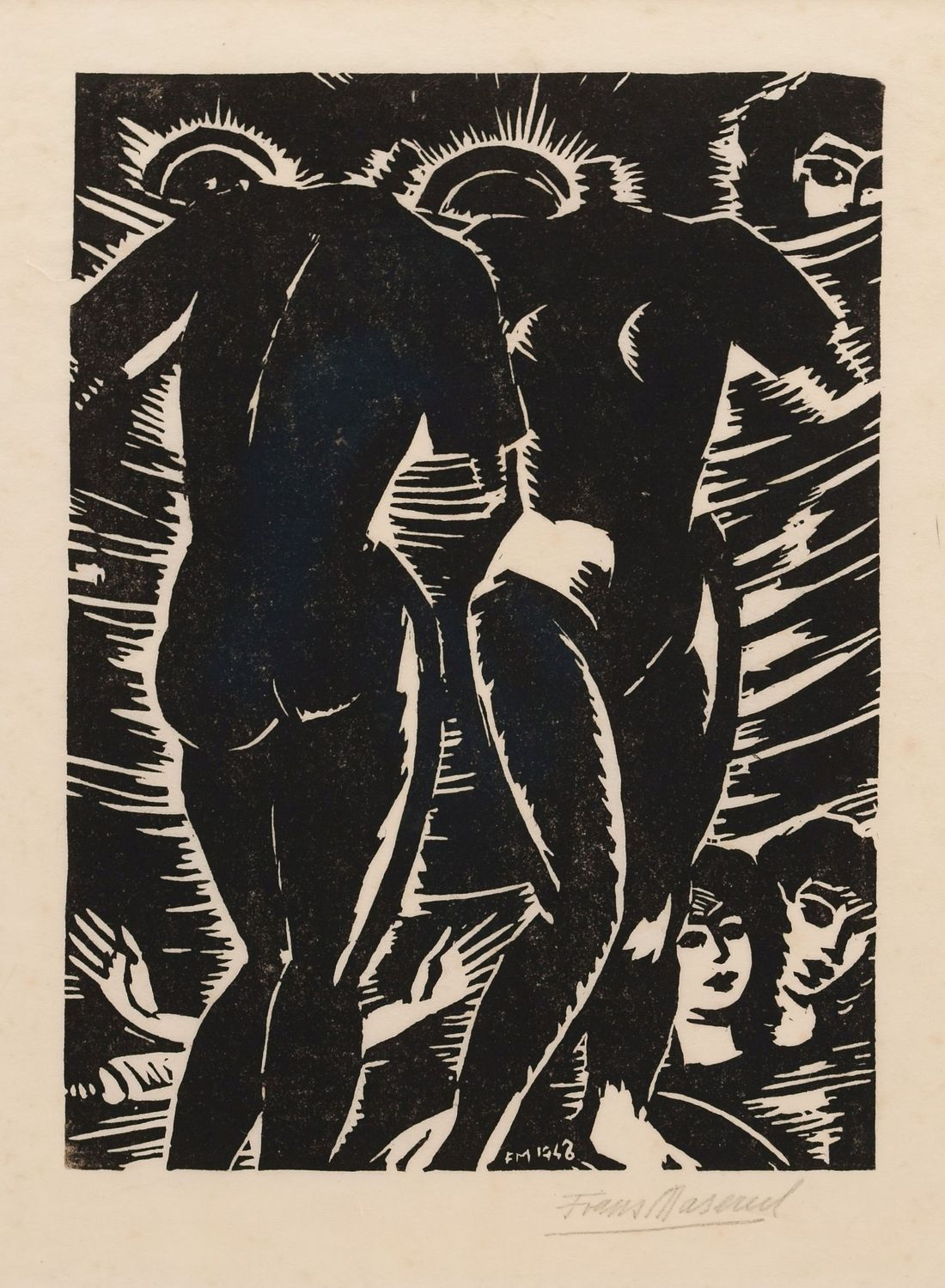
Masereel, Frans (1889-1972), Bodies and Heads, 1948
Frans Masereel(1889 Blankenberge - 1972 Avignon), Bodies and Heads , 1948. Woodcut on Japanese paper, 24.5 cm x 18 cm (image), 42.5 cm x 33.5 cm (frame), monogrammed and dated “FM 1948” in the print, signed “Frans Masereel” in pencil below.
- Image carrier slightly browned, hardly any stains, very high-contrast, powerful print. Attractively framed behind museum glass.
- The new human couple -
The figures of a man and a woman stand on a suggested round pedestal. They appear to be moving as if dancing, which is reinforced by the free, dynamic strokes. Facing each other, they embody the new human couple. But their heads are missing, and instead of necks, screw threads can be seen on their upper arms. The missing heads seem to lead a life of their own in the background, looking at the bodies standing in front of them, while the severed arms at the bottom left cheer on the male torso. Humans have become fragmented mechanical dolls that admire themselves. A real dystopia that is also evident in the intense black of the bodies. Due to the symbolic significance of the image, the sheet is a major work in Masereel's graphic oeuvre.
About the artist
Frans Masereel began studying art in Ghent at the age of 18, but his true artistic education came during extensive travels through Europe and North Africa, which sharpened his awareness of social injustices.
The outbreak of World War I marked a turning point in his life. Masereel, a staunch pacifist, refused to serve in the military and emigrated to neutral Switzerland in 1915. He found asylum in Geneva, where he worked for various political and humanitarian magazines and belonged to the circle of pacifists around Henri Guilbeaux and Romain Rolland. During this period, woodcut became his preferred artistic technique.
Masereel is considered the pioneer of the modern graphic novel, also known as the “novel without words.” He created works consisting exclusively of a sequence of woodcuts that spanned complex narrative arcs to depict human destiny in the context of war, industrialization, and social injustice. His groundbreaking works, including The Passion of a Man (1918) and My Book of Hours (1919), gained international recognition and made him a key figure in Expressionism.
After World War I, Masereel returned to Paris in 1922, where he increasingly turned to oil painting. A first retrospective of 200 of his works took place in 1929 at the Kunsthalle in Mannheim. This was immediately followed by 11 further solo exhibitions, which brought Masereel widespread recognition. Stigmatized as “degenerate” by the National Socialists, he fled Paris in 1940 and worked in the south of France. After the Second World War, Masereel worked at the newly founded State School of Art and Crafts in Saarbrücken from 1947 to 1949. He then settled in Nice to devote himself entirely to art again. Throughout his life, he remained politically active and used his art as a weapon against fascism, war, and poverty.