
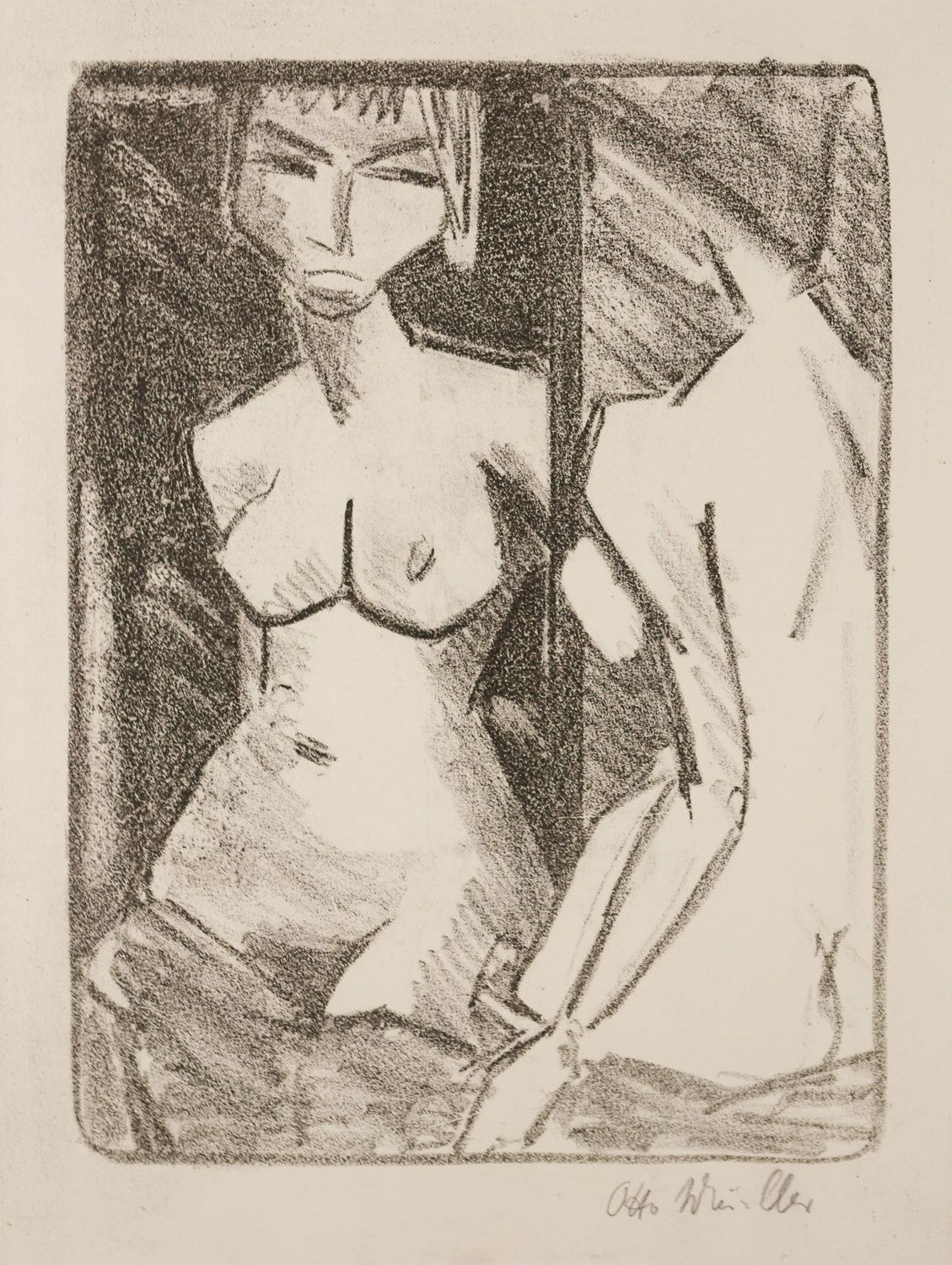
Mueller, Otto (1874-1930), Nude Girl in Front of a Mirror, 1924
Otto Mueller(1874 Liebau - 1930 Obernigk), Nude Girl Before the Mirror , 1924. Lithograph on lightly hammered handmade paper, 38.9 cm x 28.9 cm (image), 57 cm x 44 cm (sheet size), signed “Otto Mueller” in lead at the lower right. One of about 20 prints that Otto Mueller likely produced by hand in addition to the publisher’s edition of 40 copies. Karsch 132.
- strong impression, slight shadow from the printing block, small spots along the left margin, minimal dust, overall in exceptionally good condition
- The Reflection of Art -
We see a female figure characteristic of Otto Mueller’s conception of the human form, for which his second wife, Elisabeth Mueller (née Lübke), likely served as a model. The depiction is both a portrait and an illustration of femininity. The woman depicted is gazing at her own naked body in the mirror. Broad, precise strokes outline the body, while the face—particularly the eyes and eyebrows, but also the nose and mouth—emerges from precisely these same broad, precise layers of brushwork, which simultaneously stand on their own. It is the formal language of Otto Mueller’s art that has brought forth the woman “from nature,” so that her true “nature” is now revealed, which becomes present to the woman as she looks into the mirror.
The reflective mirror stands for art itself. The image reveals the “true essence,” and the image is the work of art created by Otto Mueller. Therefore, the woman turns her back to us in the “real” pictorial space, while she appears in full view in the mirror. The lithograph is thus, in addition to illustrating femininity, a programmatic reflection by Otto Mueller on his own art and, as such, a key work in his oeuvre.
About the Artist
After completing an apprenticeship as a lithographer and dropping out of art school in Dresden and Munich, Otto Mueller decided to become a self-taught artist. Beginning in 1908, he lived in Berlin, where Erich Heckel, Ernst Ludwig Kirchner, and Hermann Max Pechstein visited him in 1910 to invite Otto Mueller—whom they regarded as a pioneer of the Brücke movement—to join their art group. Otto Mueller remained a member of Die Brücke until its dissolution in 1913. During joint excursions to the Moritzburg Lakes, Mueller developed his characteristic approach to figure drawing, which combines the human form and nature in an entirely new way. During World War I, he served as a soldier and fell seriously ill. From 1919 onward, Mueller was a professor in Breslau, but his lifestyle remained that of an artistic bohemian. In the 1920s, he undertook trips to Southeast Europe, where “gypsy life” became a central theme of his work. He died of tuberculosis in 1930.
“I believe: A person who demands nothing from others, but rather enjoys what is there and processes it intellectually, will not allow others to demand anything from him either, but will calmly continue working—and do so only for those who, in turn, can enjoy what he has processed.”
Otto Mueller