
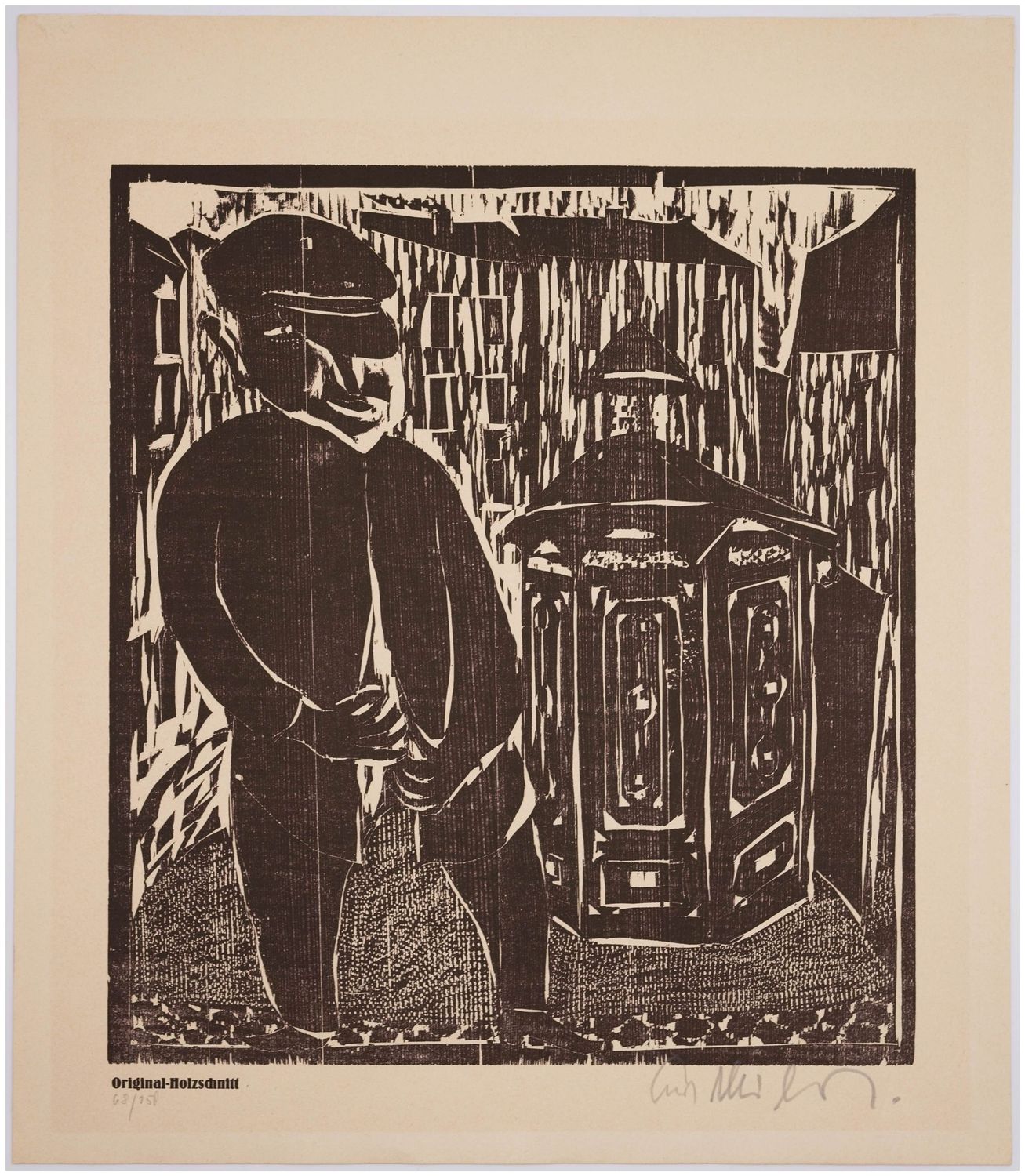
Mühlenhaupt, Kurt (1921–2006), Pinkelbude (Urinal), 1972
Kurt Mühlenhaupt(1921 Klein Ziescht - 2006 Berlin), Pinkelbude (Urinal) , 1972. Woodcut from the graphic portfolio “Rund um den Chamissoplatz” (Around Chamissoplatz), 32 cm x 29 cm (image), 41 cm x 36 cm (sheet size), signed “Curt Mühlenhaupt” in pencil at the bottom right, marked as copy no. 68/150 at the bottom left and identified as an “original woodcut.”
- Slightly darkened and with slight light edges, otherwise in good condition.
- The architecture of necessity -
The black-figured man, who fills the entire picture and wears a flat cap pulled down over his face, is in the process of closing his coat after using the urinal. A milieu study in the tradition of Heinrich Zille, although the coarser style is much more in keeping with the subject matter. But Berlin humor is also evident here: the urinal looks like a delicate and precious, almost sacred piece of architecture, from which the man has stepped out and into which he will step again and again.
About the artist
Kurt Mühlenhaupt was born and raised in a leafy colony in the Tempelhof district. He initially completed an apprenticeship as a model maker. After being drafted into the Wehrmacht, he was wounded in the war. In 1943, he took Emmi Stahlmann's art course at the West Private Art School. During the final days of the war, he was called up again, this time as a "cripple," and was wounded once more, leaving a lifelong mark on him. From 1946 to 1949, Mühlenhaupt studied at the University of the Arts Berlin under Maximilian Debus. After Karl Schmidt-Rottluff rejected him, Mühlenhaupt experienced a deep crisis that led to his admission to the Buch mental hospital. After being released, he earned a living by breeding animals until opening a junk store in 1958. The following year, he opened the artists' pub "Leierkasten" in Kreuzberg. Starting in 1963, he organized picture markets in front of his store, which evolved into the Kreuzberg art market. In 1965, he set up a printing press, and by 1969, he was living exclusively off of art. In 1971, he founded the group of Berlin painter-poets with Günter Grass, Aldona Gustas, Robert Wolfgang Schnell, and Wolfdietrich Schnurre. He acquired several farms to use as studios and moved to Bergsdorf-Zehdenick in 1990, where the Mühlenhaupt Museum is located today.