
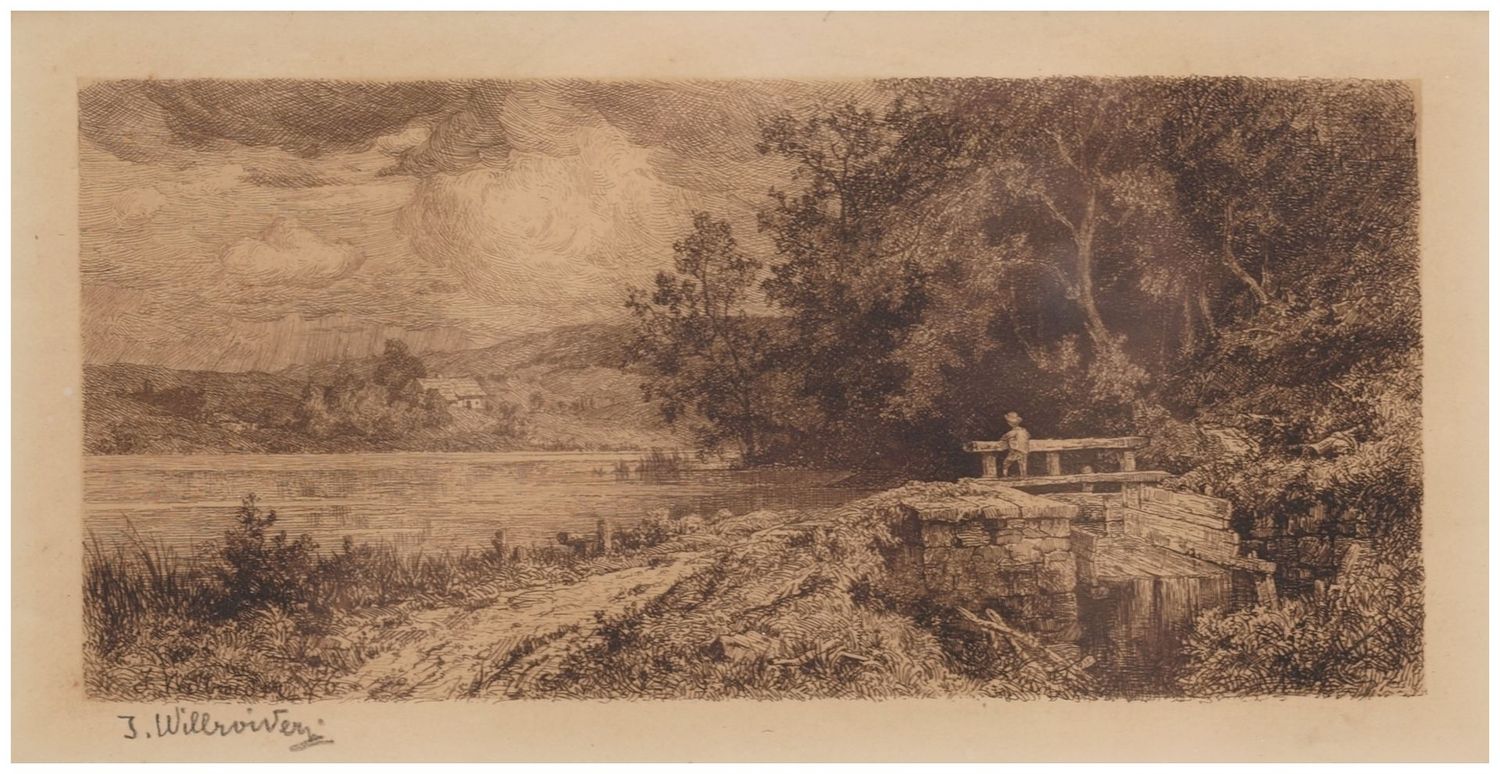
Willroider, Josef (1838-1915), View of Lake Wörthersee, around 1880
Josef Willroider(1838 Villach - 1915 Munich), View of Lake Wörthersee , around 1880. Etching, 8.3 cm x 17.7 cm (image), 26.5 cm x 37.5 cm (frame), signed “J.[osef] Willroider” in pencil below the image on the left. Framed under glass with a passe-partout.
- Slightly darkened, otherwise in good condition. Attractively framed.
- The drama of the landscape -
The elongated landscape format creates a panoramic effect that reveals the full richness of the landscape: from the delicate grasses in the foreground, which appear almost lifelike, to the rainy landscape in the background with its dramatic weather phenomena, from the bright reflections of light on the water's surface to the dark forest hollow against which the resting walker stands out. Leaning on the fence, he is the figure with whom we identify, drawing us into the picture so that we ourselves can visually stroll through the atmospherically dense landscape.
Josef Willroider combines the open-air painting practiced in the spirit of the Barbizon school with the Dutch landscape tradition of Peter Paul Rubens, thus illustrating Lake Wörthersee as a dramatic landscape experience in a smaller format.
About the artist
Josef Willroider (1838–1915) came from Villach and initially completed a craft apprenticeship before turning to painting. From 1860, he continued his education at the Munich Academy, where, under the influence of Eduard Schleich the Elder, he became acquainted with the ideas of the Barbizon School, but remained largely self-taught.
In 1866, Willroider moved to Düsseldorf, where he was influenced by the landscape painters Andreas and Oswald Achenbach. He joined the progressive artists' association “Malkasten” and undertook study trips, particularly to Holland and northern Germany.
After returning to Munich in 1889, he shared a studio with his younger brother Ludwig. The brothers often found their motifs together at Lake Starnberg near Bernried. Willroider's work mainly comprises atmospheric landscapes from Carinthia – especially views of Lake Wörthersee – as well as Bavarian and North German motifs.
In 1882, he was made an honorary member of the Royal Academy of Fine Arts in Munich for his artistic achievements. The 1870s and 1880s marked the peak of his career, during which he and his brother rose to become leading German landscape painters.