
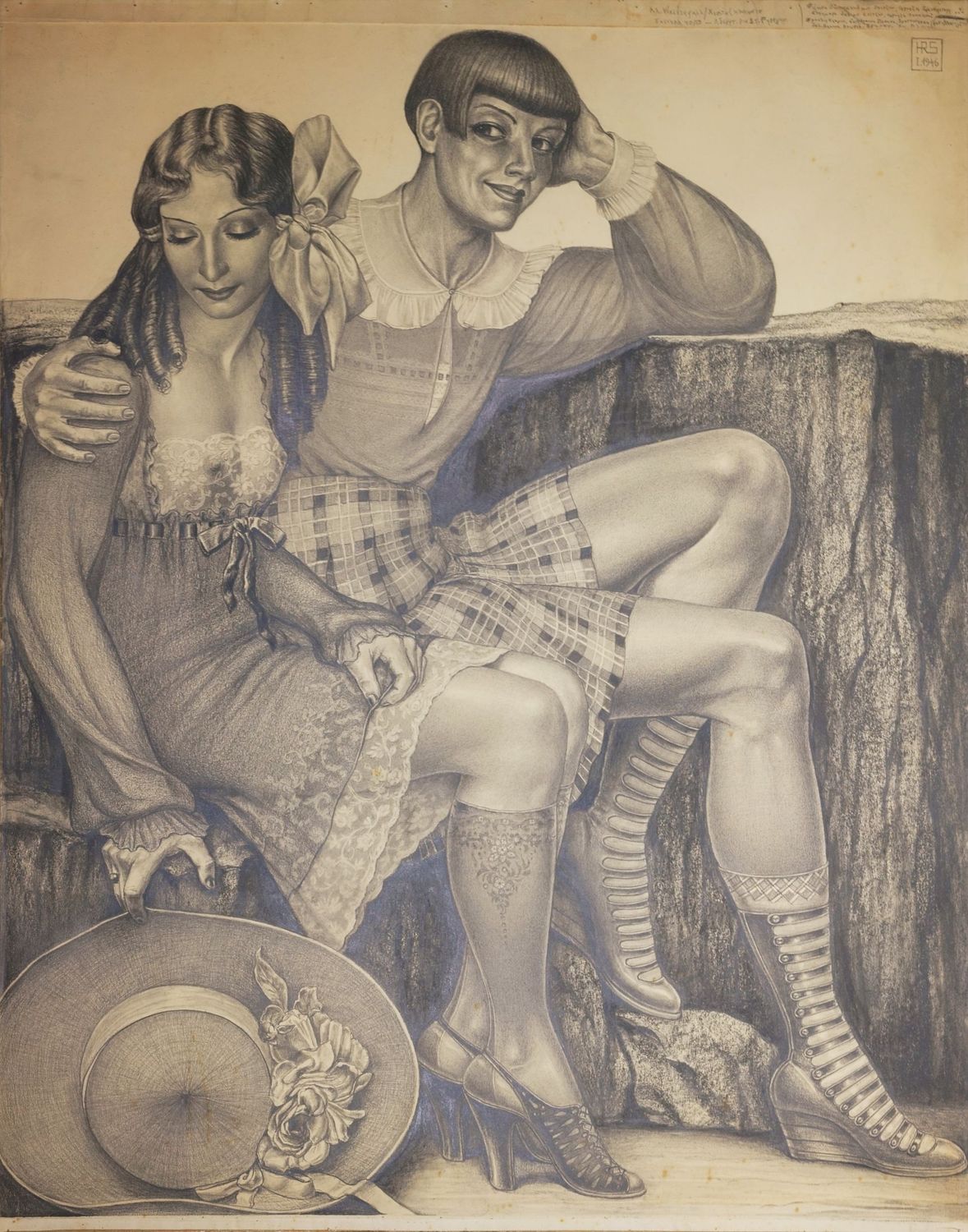
Schlegel, Herbert Rolf (1889-1972), Selbstporträt, 1946
Herbert Rolf Schlegel(1889 Breslau - 1972 Landsberg am Lech), Selbstporträt , 1946. Bleistift auf starkem Papier, 94 cm (Höhe) x 73 cm (Breite), rechts oben mit „HRS“ monogrammiert und auf Januar 1946 datiert.
- Oberkante angestückt und mit Bemerkungen auf Griechisch versehen, mitunter leicht stockfleckig, ansonsten in gutem Zustand.
- Das innere Wesen -
Im realistischen Duktus der Neuen Sachlichkeit sitzt der Künstler als Frau mit Pagenschnitt in der Landschaft und hält eine junge Dame im Arm. Dabei lehnt er sich auf eine Felskante und blickt gleichermaßen erfüllt wie herausfordernd den Betrachter an, während seine Begleiterin schüchtern und etwas versonnen nach unten schaut. Ihrem Blick folgend gewahren wir ihre Finger, mit denen sie den voluminösen, floral geschmückten Hut anhebet und ihn damit präsentiert. Neben dem Hut sind ihre eleganten Beine mit Stöckelschuhen und kniehohen, ebenfalls floral verzierten Nylonstrümpfen zu sehen, darüber die nackten Beine und das spitzenbesetzte Kleid, das über der Schleife die Brüste durch die transparente Spitze hindurch präsent werden lässt. Auf das darüber sichtbare Dekolleté fallen die frisierten Locken, die zu dem ideal anmutenden Antlitz überleiten. Die virtuos-meisterhafte Verwendung des Bleistifts lässt die Erscheinung der jungen Damen besonders fein und zart erscheinen, was den Blick bei ihrer Betrachtung bindet und die erotische Ausstrahlung noch steigert. Der Künstler in Frauengestalt hat sich seitlich zur jungen Dame positioniert, so dass beide Körper parallel zueinander erscheinen. Dadurch treten insbesondere die haarlosen Beine in eine Korrespondenz zueinander. Aber auch die Hände wirken sehr ähnlich. Es wird deutlich, dass beide ‚von demselben Fleisch‘ sind, was nicht zuletzt durch die identischen Augenbrauen hervorgehoben wird. Durch diese Gleichsetzungen tritt der eigentliche Bildsinn zutage: Die junge Dame ist der Künstler selbst, sie ist sein schüchternes inneres Wesen das er – im Arm haltend – präsentiert. Durch die Abwendung des Kopfes und die große Schleife scheint sie sich zu separieren und doch hält sie den Hut, der – von der Größe her besehen – eigentlich der Hut des Künstlers ist, was nochmals verdeutlicht, dass sie das bildlich zur Darstellung gebrachte innere Wesen des Künstlers ist. Vor diesem Hintergrund erhält auch die Landschaftsdarstellung eine tiefere psychologische Bedeutung: Die Oberfläche ist aufgebrochen und darunter erscheint das eigentliche innere Wesen, das voller Schönheit in die Welt hineinwächst und auch die äußere Gestalt des Künstlers formt.
Herbert Rolf Schlegel schafft hier eine äußerst eindringliche Introspektion, die zugleich eine Selbstoffenbarung und eine bildlich verfasste Transgendertheorie avant la lettre ist.
zum Künstler
Nach einem Studium an der Kunstgewerbeschule Düsseldorf von 1909 bis 1910 studierte der gebürtige Breslauer Herbert Rolf Schlegel von 1910 bis 1911 an der Kunstschule Weimar bei Fritz Mackensen und Ludwig von Hofmann. Von 1911 bis 1913 lebte er auf Bornholm, um sich selbstständig in Figuren- und Landschaftsmalerei weiterzubilden. Danach setzte er sein Studium an der Kunstakademie Kassel fort und wurde 1914 Meisterschüler von Hans Olde. Im Ersten Weltkrieg war er von 1915 bis 1918 als technischer Zeichner im Einsatz. Während des Krieges lernte er Elisabeth Petersen kennen, die er 1919 heiratete. 1921 ereilte ihn ein Schicksalschlag: Seine Frau und ihr gemeinsames Kind starben kurz nach der Geburt. Nachdem Schlegel sein Studium in Kassel mit Auszeichnung als bester Schüler abgeschlossen hatte, zog er 1924 an den Ammersee nach St. Georgen bei Dießen und ließ sich später bei Schondorf nieder. Dort leitete er ab 1932 die Töpferei des Landheims Schondorf und arbeitete als Kunsterzieher am Gymnasium. Er malte unter anderem ein Altarbild für die evangelische Kirche in Utting und war Mitglied der Künstlergilde Landsberg-Lech und Ammersee. Nach seinem Diest im Zweiten Weltkrieg gründete er in seinem Atelier eine Privatschule für angehende Kunststudenten.